Wolf Range Repair
Wolf burner ticks steadily and never catches: five things to check
A Wolf surface burner that sparks endlessly without catching is nearly always one of five things, and four of them you can rule out at the cooktop in ten minutes. What the clicking is, what to check, and when to stop.
Written by Dallas McGivern Cooking-appliance technician — griddles and charbroilers · 10 years in the trade
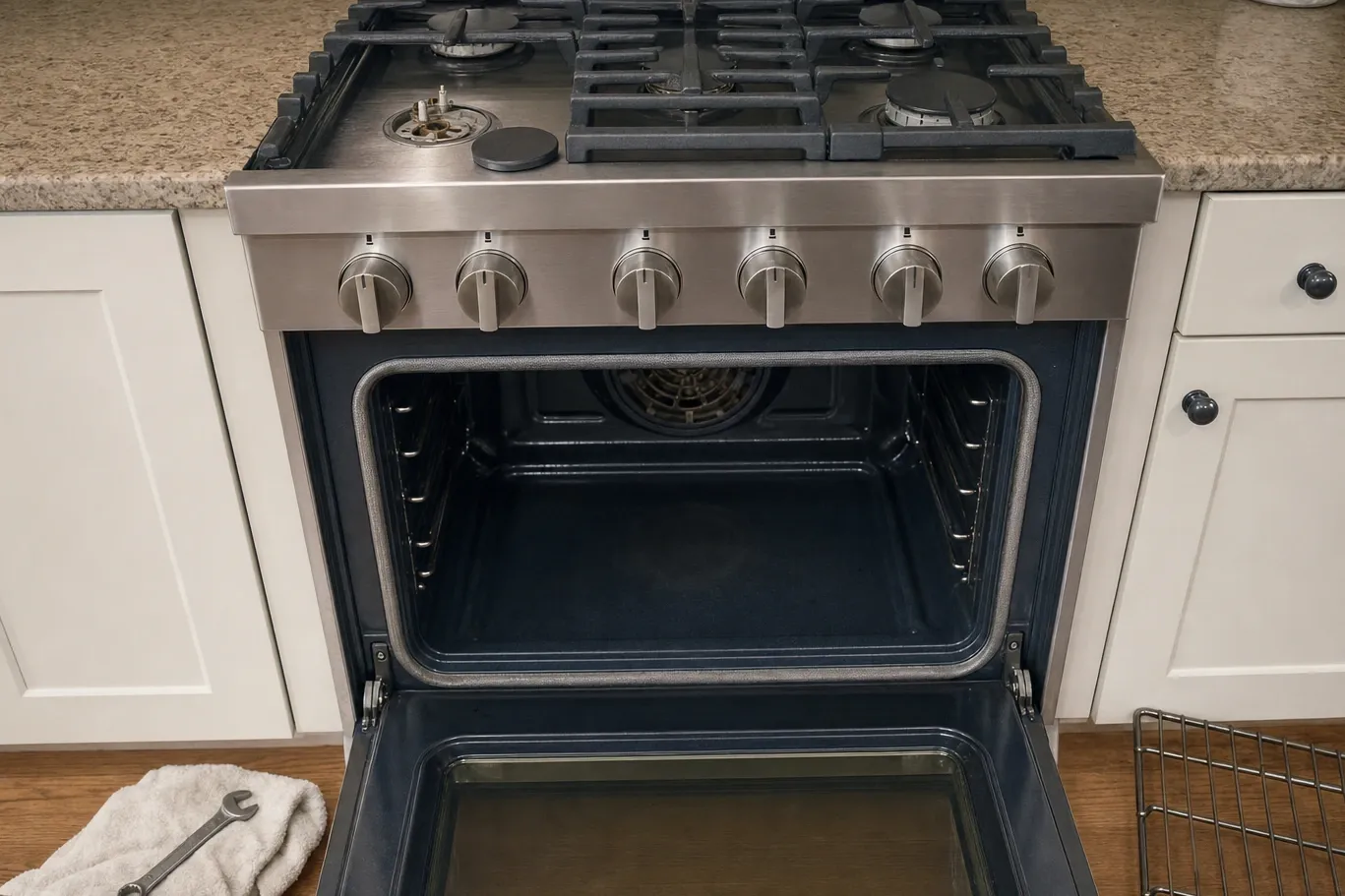
A Wolf burner that ticks steadily and never catches is one of the two or three most common calls this shop takes, and it is worth understanding before you pick up the phone — because roughly half the time the fault is something you can see from standing height with the grate off.
What the clicking actually is
The tick is a spark module firing a high-voltage arc across a gap between a ceramic electrode and the burner base. It is the same idea as a spark plug, and it needs three things at once: voltage at the electrode, a clean gap to jump, and gas in that gap ready to catch.
On a Wolf sealed-burner cooktop or the top of a dual-fuel range, one module usually feeds every electrode in parallel. That is why turning one knob makes all four or six burners tick. It looks alarming and it is completely normal.
What is not normal is sparking that carries on after a burner has lit. The module should sense the flame and stop. When it keeps going, it is not seeing what it expects — and that points at the electrode or its earth path rather than at the gas.
The five things that stop a burner lighting
Ordered by how often each one turns out to be the culprit:
- Grit or spillage in the spark gap. Fine dust after a storm, or the dried remains of something that boiled over. The arc still fires but there is nothing for it to ignite.
- A cracked or tracking electrode. The ceramic insulator carries the high-voltage lead to the tip. Once it is chipped or crazed, the spark takes a shortcut down the side to the burner base instead of jumping the gap. You often hear the tick move to a different place.
- Blocked burner ports on the side nearest the electrode. Gas arrives but not where the spark is. Symptom: it lights eventually, from one side, with a small pop.
- A tired spark module. Under a Phoenix cooktop the module sits at ambient plus whatever the burners are radiating, all summer, every summer. They do not fail often, but when they do it is here rather than in a cooler climate.
- The switch behind the knob. A tiny switch that tells the module to fire. Years of frying puts grease into it, and it either stops making contact or stops letting go — which is the other cause of endless clicking.
What you can check in ten minutes
Turn the burner off first, and give the area a minute to clear.
- Lift the cap and ring. They come straight off cold. Look at the ceramic electrode: it should be clean, pale and unchipped, with the tip a couple of millimetres from the burner base.
- Brush the ports. A stiff brush and a straightened paperclip. Do not use a drill bit or anything that will widen a port — the size is a spec, not a suggestion.
- Look for a wet or black electrode. Wipe it dry with a cloth, not with water. A damp electrode after a boil-over will not spark properly and may come good once dry.
- Try a match. If the burner lights and runs a clean blue flame from a match, gas and the valve are fine and the fault is purely ignition.
- Compare burners. Turn each one on in turn and listen. If one electrode ticks in a duller or different place, that is your suspect.
If the burner lights and stays lit after brushing and drying, you have finished. That is the outcome to hope for.
When the click is a reason to stop and call
Some versions of this are not a ten-minute job:
- You can smell gas with everything off. Shut the supply at the valve behind the range and stop. That is not an ignition fault.
- The burner lights with a soft thump. Gas has been collecting before it catches. It is usually a slow valve or a badly blocked burner, and it should not be left running.
- The flame lifts off the burner or burns yellow with soot. Wrong orifice sizing or a manifold pressure that has never been set for this house. That needs a gauge on the manifold, not an adjustment by eye.
- Nothing ticks at all on any burner. Now you are looking at the module, its supply or the switch, all of which live behind the control panel.
What the repair looks like on the day
Ignition faults are among the better ones to have. Electrodes, spark modules and knob switches for the common Wolf families ride on the van as standard, because this climate goes through them. The diagnosis is quick and it is a measurement rather than a guess: continuity at the switch, the spark path checked at the electrode, and manifold pressure read with a gauge if the flame quality is in question at all.
The flat $89 service call covers the visit and that whole diagnosis, and it comes off the bill once you approve the repair. If it turns out to be grit and a brush, you will be told that too — and shown, with the cap off, so you can do it yourself next time.
Follow-ups
- Is it safe to keep pressing the knob while it clicks?
- For a few seconds at a time, yes — the spark is a low-current, high-voltage arc and the gas flow is small. What is not safe is holding a knob open for half a minute so unburnt gas collects under a lid or in a cabinet recess. Push, count to five, release, let it clear, try again.
- Why do all the burners spark when only one is turned on?
- Most Wolf sealed-burner tops run one spark module feeding every electrode in parallel, so every burner ticks whichever knob you turn. That is normal. Sparking that continues after a burner has lit is not — it means the module is not seeing a flame and it usually points at the electrode or its earth path.
- The burner lights with a match. Does that narrow it down?
- Considerably. Gas is arriving and the valve is opening, so the fault is on the ignition side rather than the supply side — the electrode, its lead, the switch behind the knob, or the module. It also means the burner is safe to use with a match in the meantime on an all-gas top.
- Can grit from a dust storm really stop a burner lighting?
- Yes, and it is one of the more common Phoenix versions of this fault. Fine grit settles in the burner ports nearest the spark gap and in the gap itself. The flame then has nothing to travel across, so the burner lights on one side and goes out, or never catches at all.